

Luisa Olivera
March 2026
Luisa Olivera is an artist-designer working between interactive art and modular jewelry, combining craftsmanship, 3D printing, and recycled materials. Winner of the Hermès Fashion Accessories Prize at the 40th Hyères Festival in 2025 and the ADAGP Revelation Design Prize in 2024, she creates lightweight sculptural pieces that merge technical research with poetic expression, all handmade in her Paris studio.
Photos by Margaux Salarino
Temple Magazine
Your work moves between sculpture, jewelry, and interactive design. How would you describe your practice today, and how did it take shape?
Luisa Olivera
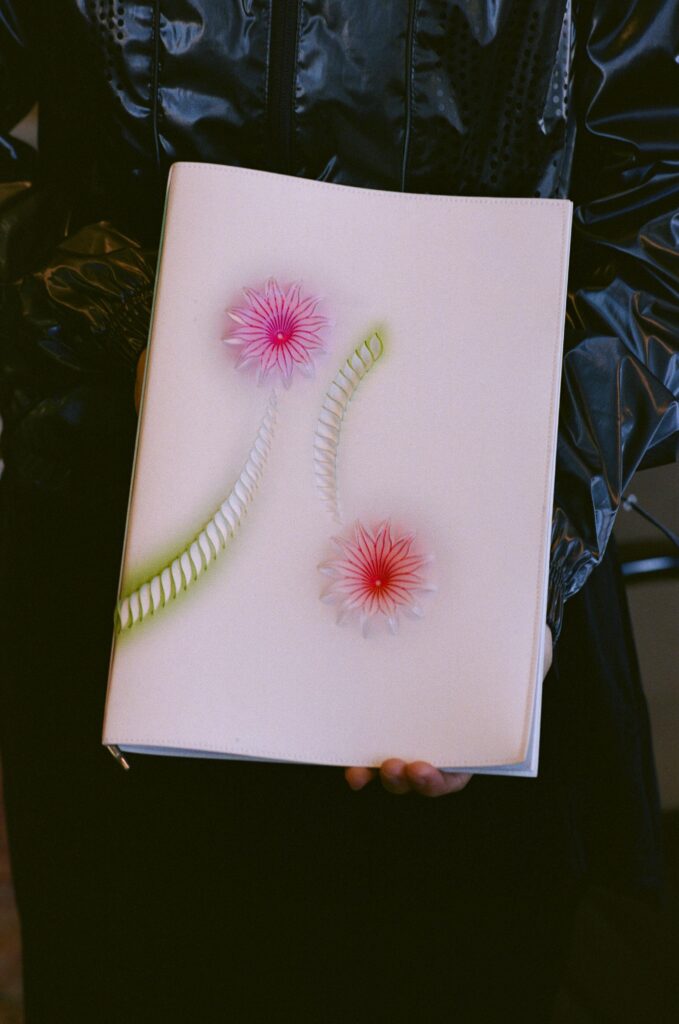
I work mainly with organic forms, and I focus a lot on interaction and modularity through a process I call Active Tensile Structures. Through this, I have studied a number of bistable structures and the tension of textiles. As for the creative process, there are many back-and-forth moments and a lot of reflection, because it is a highly experimental process, and it also depends on the purpose of the piece. Over the past few years, I have accumulated many study pieces in which I explored simple geometric forms as well as a wide variety of organic structures.
I have worked extensively with collage and assemblage, trying for example to imitate or take inspiration from existing flowers. So it is a combination of drawings from earlier works, creating new assemblages from them, and of course producing new drawings inspired by a specific reference.
Temple Magazine
Yes, flowers and organic forms constantly reappear in your work. Why flowers? What do they represent for you?
Luisa Olivera
I chose the flower because it’s a way of embedding a long-lasting memory. When I was in Honduras, I was in very regular contact with nature, and I think that is almost what I miss the most in France. I feel a very particular attraction to nature, whether plant life or fauna. I have become deeply fascinated by the movement principles of plants, especially thigmonasty, the way a plant reacts when it is touched. Before focusing on the floral subject, I had conducted research around geometric forms that react to touch. It is the idea of tension that interests me first, before the flower itself. But through the flower, I find an extremely interesting formal entry point that also resonates with me on a more emotional level, not only on a technical one. I knew it could potentially take years to further develop this theme.
It’s a subject that creates connections between people. It may be considered a bit basic, a kind of classical beauty, but I am comfortable with that. I think it’s interesting to work with classical beauty as well. It feels good too.
Temple Magazine
With this hybrid form that you have created; you combine craftsmanship, 3D printing, and recycled materials. Concretely, how does it work in your studio? What does your process look like, from the first gesture to the final piece?
Luisa Olivera
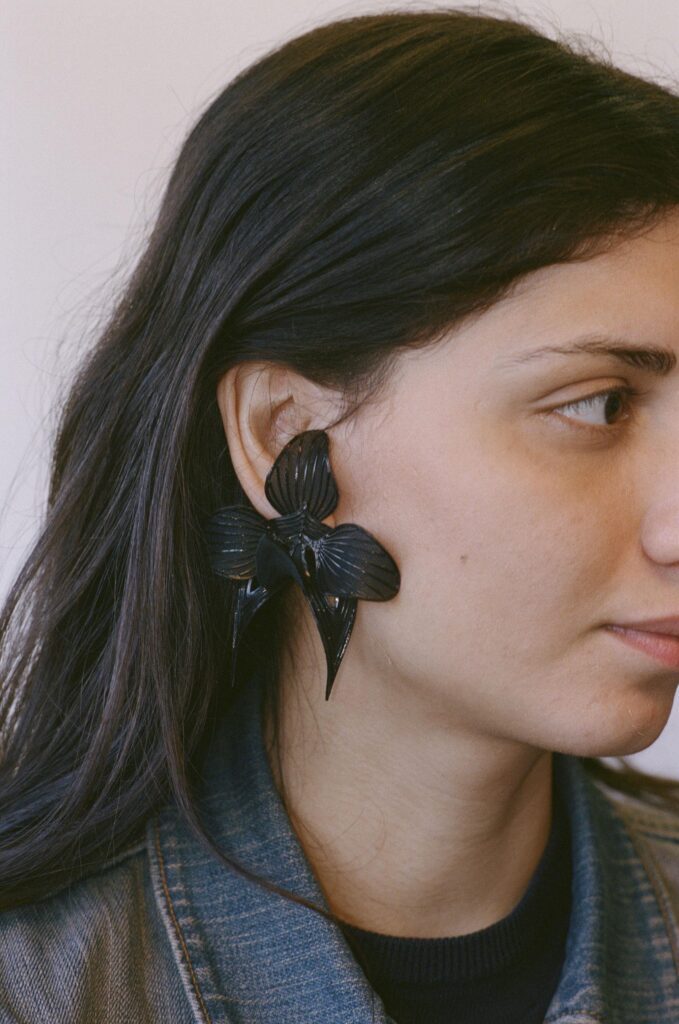
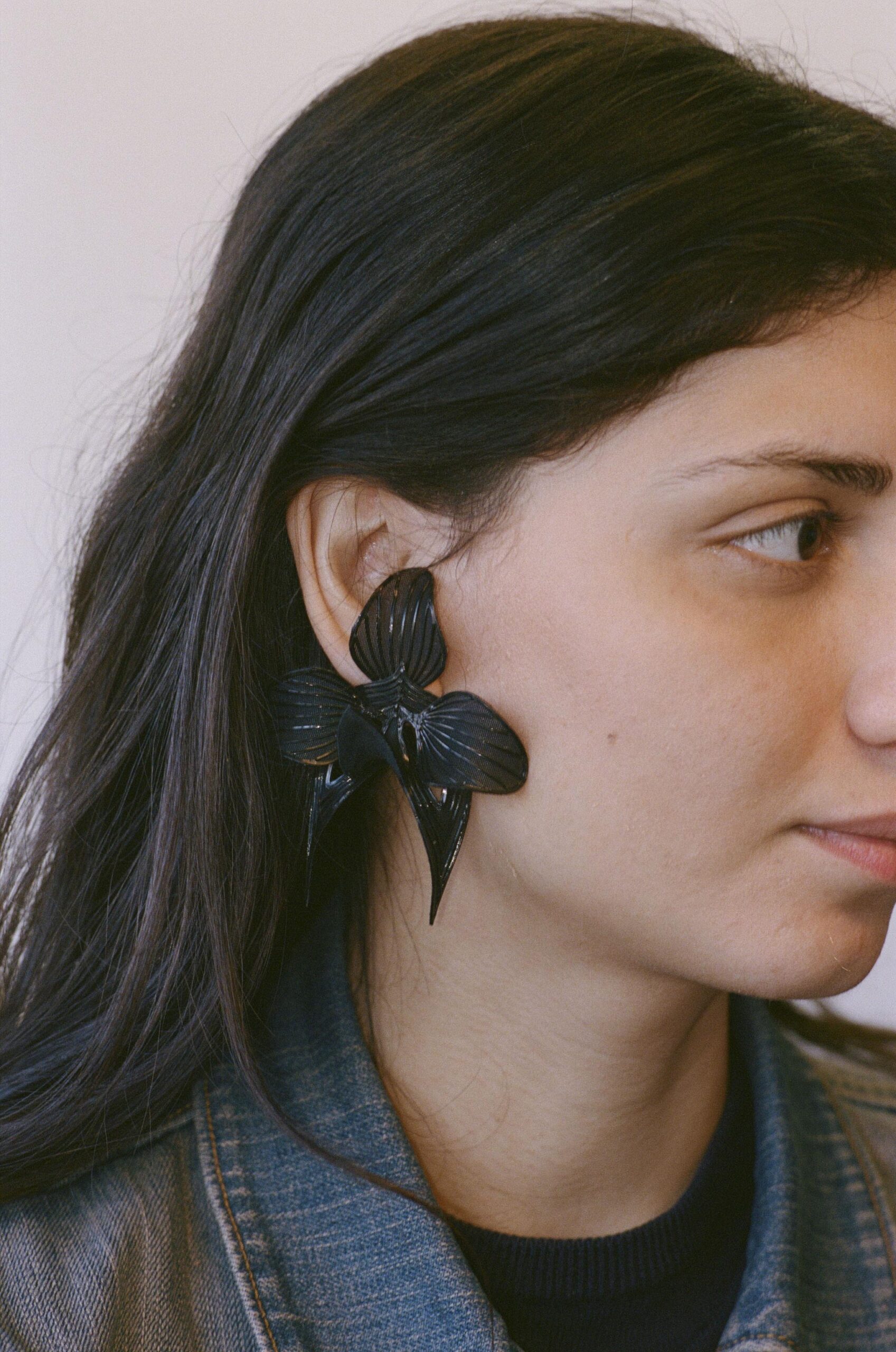
Regarding the fact that my work lies between jewelry and sculpture, the function often comes after the form I develop. It is something that can adapt to the body, or not. It is a bit complex, but let’s say I can develop a form first and then see whether it could correspond to different parts of the body. For example, the wrist if it becomes a bracelet, or the ear if it sits around the face.
If I feel that the shape of the piece does not create harmony with the form of the body, that is not necessarily a problem for me, because it remains a sculpture anyway. In the case of jewelry, it is simply a sculpture that is aesthetically pleasing, or that can be worn in harmony with the body’s form.
Function can come at the end. At the moment, however, I am trying to work on both aspects simultaneously, developing sculptures and then creating jewelry from those sculptures, within the same thematic framework but not necessarily with the exact same forms.
Temple Magazine
Your palette is highly recognizable: almost artificial, acidic, sometimes unreal colors. Where does this palette come from? Is it a way of pulling the flower away from naturalism, or of projecting it somewhere else?
Luisa Olivera
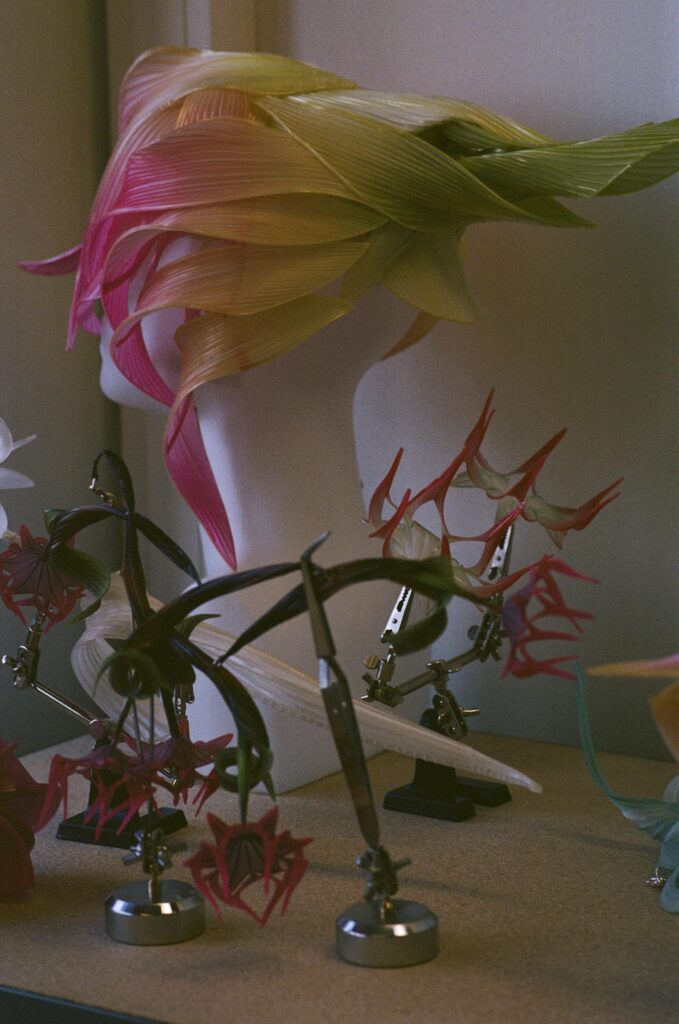
Regarding the colored hairpieces, it is increasingly a blend of different elements. It begins with a concrete inspiration, whether from an existing flower or not necessarily a flower, but also an animal or another element. For example, during the Hyères Festival at villa Noailles, I constructed the color range from certain inspirations that established the first foundations defining the palette. The remaining colors were selected by seeking contrasts or harmonies to create dialogue with the initial color ranges that had been chosen.
Temple Magazine
And your display stands, are those pieces you make yourself as well?
Luisa Olivera
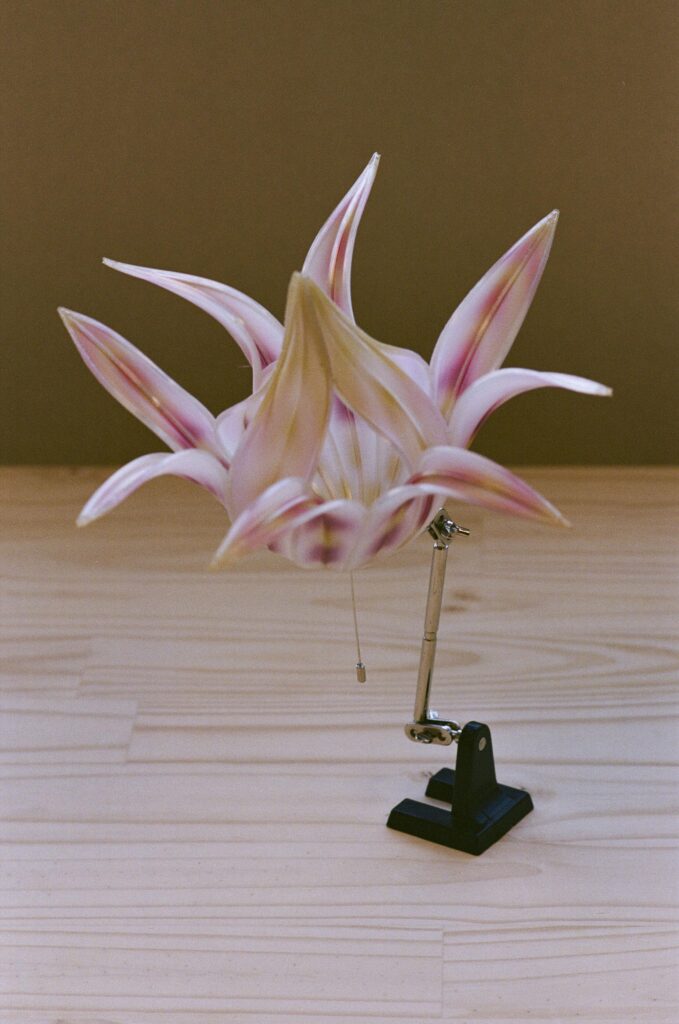
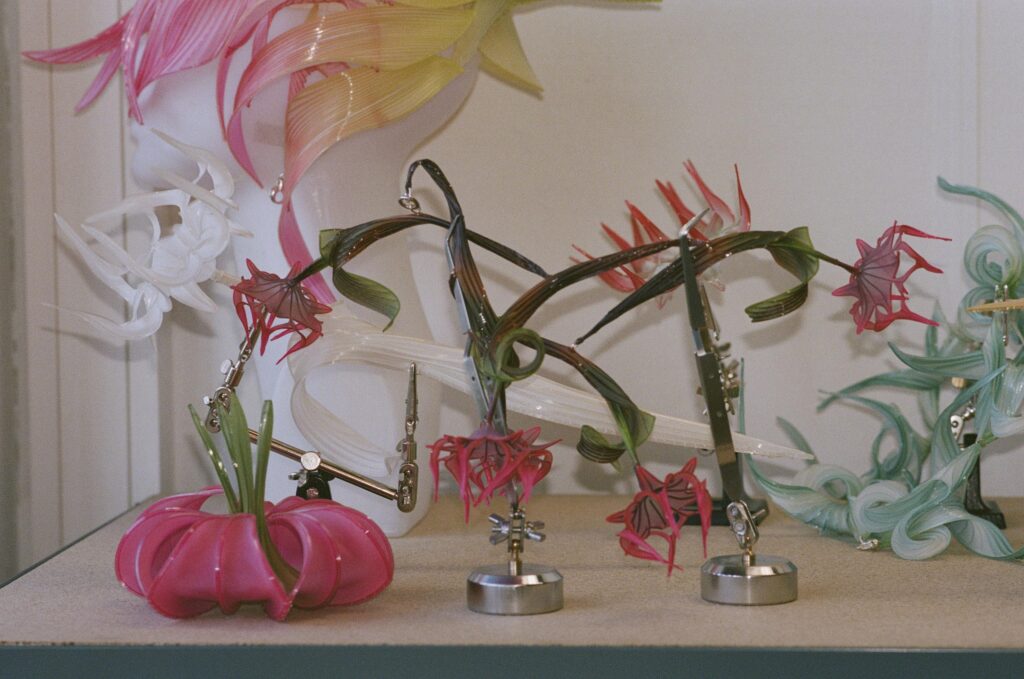
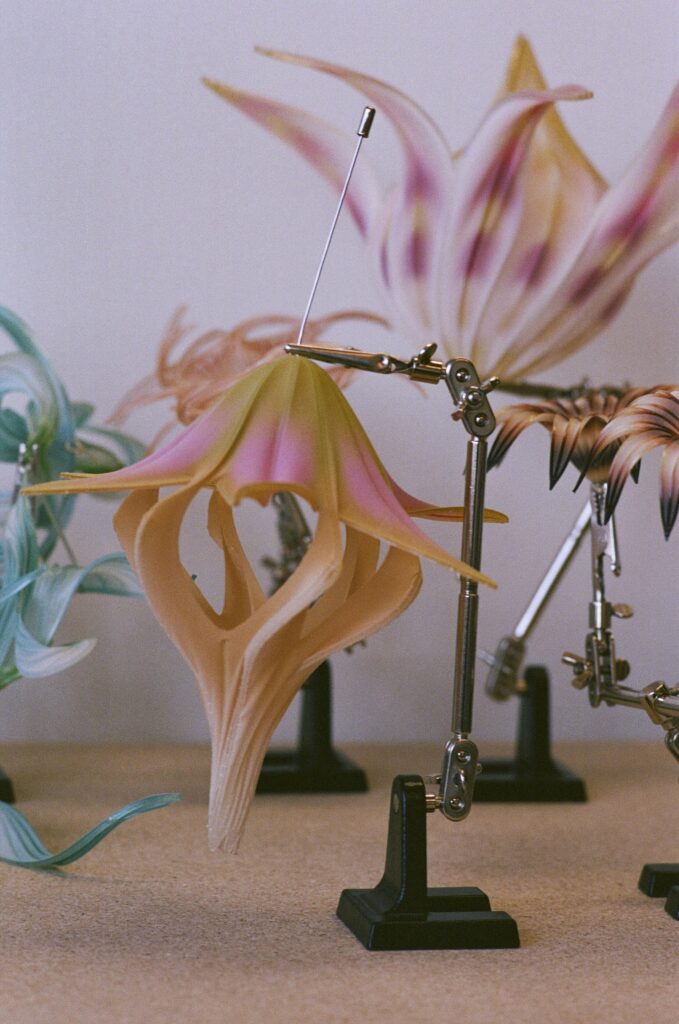
No, the stands are not pieces I make myself. They were originally tools I used for working, but they gradually became presentation elements because I found it interesting to reveal that technical aspect. They show that the pieces are handcrafted, made manually, and not produced entirely by a machine.
Temple Magazine
Because it reinforces that dimension? It gives a kind of researcher feeling?
Luisa Olivera
Yes. Normally, they are watchmaking clamps or clamps used for soutache work, tools people use to hold and manipulate small objects. At first, I had not thought about them in that way at all. I started using them simply because they were available at the École des Arts Décoratifs, where students use them for soldering. But while working with these clamps, I realized they directly contributed to the way I present my pieces. I find them visually beautiful as well.
Temple Magazine
Since your pieces are active, how do you imagine creating this dialogue within an exhibition? It has become quite rare today to see pieces that can be handled, that can be touched. How do you envision developing that?
Luisa Olivera
I find it interesting from both an art and design perspective. Originally, I conceived it as a design principle. My initial intention was to create modular jewelry. But then I realized, almost by accident, that it was extremely pleasant simply to manipulate the piece. I understood that there was something to develop further in that direction.
I want to continue exploring these modular and interactive aspects as much as possible, but I do not want it to become an obligation for every project I create. It is something I want to develop depending on the project and its specific interest.
Temple Magazine
And today, how would you define your project or your brand? And in which direction would you like to see it evolve over the next few years?
Luisa Olivera
I am currently working in a commercial line of my jewelry pieces, which will stay very artisanal and in a limited production, the same way my conceptual pieces are created today. I am working on this while also developing further my artistic path, in which a piece of jewelry corresponds to a sculpture, and a sculpture can also evolve into a piece of jewelry. Always within an exhibition format, with a clearly defined story.
I regularly note different ways this interaction could evolve into an art installation. For example, I would love to explore principles of communication through opening and closing mechanisms. One could imagine a field of flowers where opening and closing the flowers in a specific pattern could transmits a message through interaction.

Temple Magazine
Your work moves between sculpture, jewelry, and interactive design. How would you describe your practice today, and how did it take shape?
Luisa Olivera
I work mainly with organic forms, and I focus a lot on interaction and modularity through a process I call Active Tensile Structures. Through this, I have studied a number of bistable structures and the tension of textiles. As for the creative process, there are many back-and-forth moments and a lot of reflection, because it is a highly experimental process, and it also depends on the purpose of the piece. Over the past few years, I have accumulated many study pieces in which I explored simple geometric forms as well as a wide variety of organic structures.
I have worked extensively with collage and assemblage, trying for example to imitate or take inspiration from existing flowers. So it is a combination of drawings from earlier works, creating new assemblages from them, and of course producing new drawings inspired by a specific reference.
Temple Magazine
Yes, flowers and organic forms constantly reappear in your work. Why flowers? What do they represent for you?
Luisa Olivera
I chose the flower because it’s a way of embedding a long-lasting memory. When I was in Honduras, I was in very regular contact with nature, and I think that is almost what I miss the most in France. I feel a very particular attraction to nature, whether plant life or fauna. I have become deeply fascinated by the movement principles of plants, especially thigmonasty, the way a plant reacts when it is touched. Before focusing on the floral subject, I had conducted research around geometric forms that react to touch. It is the idea of tension that interests me first, before the flower itself. But through the flower, I find an extremely interesting formal entry point that also resonates with me on a more emotional level, not only on a technical one. I knew it could potentially take years to further develop this theme.
It’s a subject that creates connections between people. It may be considered a bit basic, a kind of classical beauty, but I am comfortable with that. I think it’s interesting to work with classical beauty as well. It feels good too.
Temple Magazine
With this hybrid form that you have created; you combine craftsmanship, 3D printing, and recycled materials. Concretely, how does it work in your studio? What does your process look like, from the first gesture to the final piece?
Luisa Olivera
Regarding the fact that my work lies between jewelry and sculpture, the function often comes after the form I develop. It is something that can adapt to the body, or not. It is a bit complex, but let’s say I can develop a form first and then see whether it could correspond to different parts of the body. For example, the wrist if it becomes a bracelet, or the ear if it sits around the face.
If I feel that the shape of the piece does not create harmony with the form of the body, that is not necessarily a problem for me, because it remains a sculpture anyway. In the case of jewelry, it is simply a sculpture that is aesthetically pleasing, or that can be worn in harmony with the body’s form.
Function can come at the end. At the moment, however, I am trying to work on both aspects simultaneously, developing sculptures and then creating jewelry from those sculptures, within the same thematic framework but not necessarily with the exact same forms.
Temple Magazine
Your palette is highly recognizable: almost artificial, acidic, sometimes unreal colors. Where does this palette come from? Is it a way of pulling the flower away from naturalism, or of projecting it somewhere else?
Luisa Olivera
Regarding the colored hairpieces, it is increasingly a blend of different elements. It begins with a concrete inspiration, whether from an existing flower or not necessarily a flower, but also an animal or another element. For example, during the Hyères Festival at villa Noailles, I constructed the color range from certain inspirations that established the first foundations defining the palette. The remaining colors were selected by seeking contrasts or harmonies to create dialogue with the initial color ranges that had been chosen.
Temple Magazine
And your display stands, are those pieces you make yourself as well?
Luisa Olivera
No, the stands are not pieces I make myself. They were originally tools I used for working, but they gradually became presentation elements because I found it interesting to reveal that technical aspect. They show that the pieces are handcrafted, made manually, and not produced entirely by a machine.

Temple Magazine
Because it reinforces that dimension? It gives a kind of researcher feeling?
Luisa Olivera
Yes. Normally, they are watchmaking clamps or clamps used for soutache work, tools people use to hold and manipulate small objects. At first, I had not thought about them in that way at all. I started using them simply because they were available at the École des Arts Décoratifs, where students use them for soldering. But while working with these clamps, I realized they directly contributed to the way I present my pieces. I find them visually beautiful as well.
Temple Magazine
Since your pieces are active, how do you imagine creating this dialogue within an exhibition? It has become quite rare today to see pieces that can be handled, that can be touched. How do you envision developing that?
Luisa Olivera
I find it interesting from both an art and design perspective. Originally, I conceived it as a design principle. My initial intention was to create modular jewelry. But then I realized, almost by accident, that it was extremely pleasant simply to manipulate the piece. I understood that there was something to develop further in that direction.
I want to continue exploring these modular and interactive aspects as much as possible, but I do not want it to become an obligation for every project I create. It is something I want to develop depending on the project and its specific interest.

Temple Magazine
And today, how would you define your project or your brand? And in which direction would you like to see it evolve over the next few years?
Luisa Olivera
I am currently working in a commercial line of my jewelry pieces, which will stay very artisanal and in a limited production, the same way my conceptual pieces are created today. I am working on this while also developing further my artistic path, in which a piece of jewelry corresponds to a sculpture, and a sculpture can also evolve into a piece of jewelry. Always within an exhibition format, with a clearly defined story.
I regularly note different ways this interaction could evolve into an art installation. For example, I would love to explore principles of communication through opening and closing mechanisms. One could imagine a field of flowers where opening and closing the flowers in a specific pattern could transmits a message through interaction.